The challenges of traditional marketing controlling
In modern B2B business, transparency in marketing and sales is essential, but often difficult to achieve. Traditional marketing controlling relies on manual processes and extensive Excel lists. This approach is not only time-consuming, but also prone to errors. Companies easily lose track and important key figures get lost in the flood of data.
The lack of real-time data means that decisions are often based on outdated or incomplete information. This inhibits the ability to react quickly and effectively to market changes. In addition, manual processes are often not scalable, which is a significant problem for growing companies.
Advantages of automated dashboards
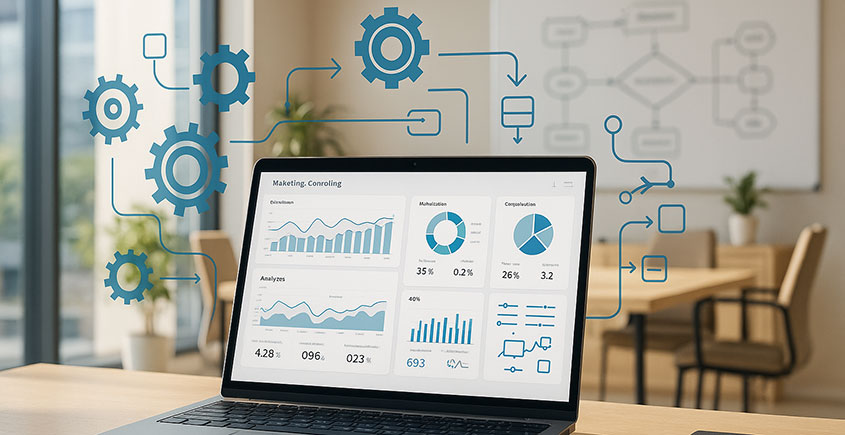
Automated dashboards offer a solution to these challenges by providing real-time insights into all relevant KPIs (Key Performance Indicators). These systems update themselves automatically and therefore always provide up-to-date data that companies can rely on.
A key advantage of automated dashboards is the time they save. Marketing and sales teams no longer have to spend hours collecting and analyzing data. Instead, they can concentrate on interpreting the data and implementing strategic measures.
Another advantage is the reduction of error sources. Automated systems minimize the risk of human error when entering and processing data. This leads to more accurate and reliable data, which serves as the basis for well-founded decisions.
Which key figures really count
It is crucial to understand which KPIs are really important. Not all data is equally relevant, and focusing on the wrong KPIs can lead to ineffective strategies. Important metrics in B2B marketing include lead conversion rate, customer lifetime value (CLV) and cost per lead (CPL).
Targeted marketing controlling focuses on these key performance indicators in order to make the company’s success measurable. Automated dashboards make it possible to monitor these KPIs in real time and react quickly to changes.
Minimize sources of error through automation
Automation eliminates many of the typical sources of error in marketing controlling. Manual data entry and processing are prone to errors that can lead to incorrect conclusions and inefficient measures. Automated systems ensure that data is recorded consistently and accurately.
In addition, automated dashboards offer the possibility of integrating and consolidating data from different sources. This leads to a more comprehensive and accurate picture of marketing performance. The ability to update data in real time reduces the risk of outdated information and enables rapid responses to market changes.
Practical examples of successful implementation
Many companies have already recognized and successfully implemented the benefits of automated dashboards. One example is a medium-sized mechanical engineering company that has optimized its marketing and sales processes by introducing an automated dashboard.
By monitoring their KPIs in real time, they were able to identify bottlenecks more quickly and take targeted measures. This led to a significant increase in the lead conversion rate and a reduction in marketing costs. Another example is a software company that was able to significantly improve the transparency and efficiency of its marketing campaigns by using automated dashboards.
The path to proactive action in B2B marketing
Automated dashboards enable companies to move from a reactive to a proactive marketing strategy. Instead of just reacting to changes, companies can recognize trends and patterns early on and take appropriate action.
This creates a new level of predictability in everyday life and enables strategic decisions to be made on the basis of accurate and up-to-date data. Companies that adopt this approach can better coordinate their marketing and sales activities and thus achieve a real competitive advantage.
Overall, automated dashboards offer a number of advantages for B2B companies. They create transparency, reduce sources of error and enable proactive action. Companies that rely on these technologies are better equipped to succeed in the modern, fast-moving business environment.
About the author:

Ingo Marggraf, Geschäftsführer der ComCare 360 GmbH, ist ein erfahrener Experte im Bereich Marketing, Vertrieb, Telemarketing und CRM-Systemen. Mit seinem umfangreichen Wissen und seiner Leidenschaft für innovative Lösungen hilft er Unternehmen dabei, ihren Umsatz zu steigern und erfolgreich zu wachsen.