
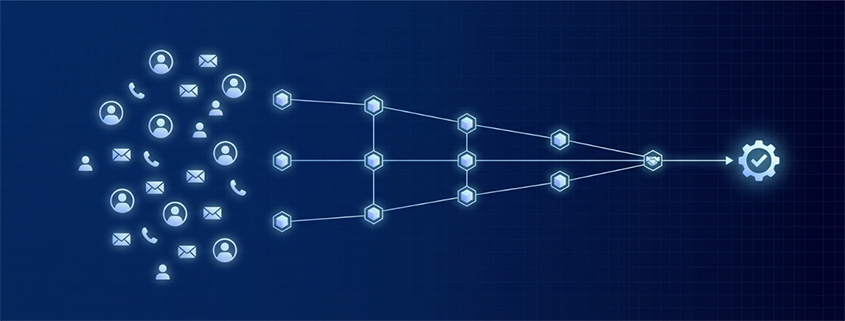
Trade fair contacts alone do not bring sales – only the right follow-up turns business cards into real customers.
This article shows how companies systematically qualify their trade fair contacts and convert them into paying customers. You’ll learn what mistakes are typical when following up, how to effectively prioritize leads, build a multi-step follow-up path, and use modern CRM tools such as HubSpot .
⏱️ Reading time: approx. 7 minutes
- Why Most Trade Show Leads Remain Worthless
- What is lead qualification – and why is it crucial?
- Step 1: Categorize contacts instantly – the BANT model
- Step 2: The follow-up sequence – timing is everything
- Step 3: Content that convinces instead of annoying
- CRM and Tools: The Technical Foundation
- Typical mistakes and how to avoid them
- Conclusion: Contacts become customers – step by step
Why Most Trade Show Leads Remain Worthless
Trade fairs are expensive: stand rental, staff, travel, overnight stays – the costs quickly add up to five- or even six-figure amounts. But what happens to the collected business cards and contacts afterwards? In many companies, they end up in a stack of cards on the desk or are half-heartedly transferred to an Excel spreadsheet – and then? Nothing.
Studies show that up to 80% of all trade fair contacts are never systematically followed up. This means that the investment in the trade fair almost completely fizzles out. The reason is rarely a lack of motivation, but a lack of structure. Sales reps come back from the trade fair exhausted, everyday life catches up with them immediately, and the leads disappear into nirvana.
The potential is obvious: people who actively attend a trade fair and stop at your stand have already shown interest. They’re not cold calling contacts – they’re pre-qualified prospects. What is missing is the consistent continuation of this impulse.
What is lead qualification – and why is it crucial?
Lead qualification means evaluating and prioritizing incoming contacts: Who is genuinely interested in buying? Who is still in the early research phase? And who is simply not a suitable customer for your offer?
Without this assessment, your sales team wastes valuable time on contacts that don’t come to fruition—while hot leads go cold because they have to wait too long. Lead qualification creates clarity, saves resources and significantly increases the closing rate.
After a trade fair, qualification is particularly important because the mass of contacts is large and the information situation is often thin: A short conversation at the booth is rarely enough to assess the actual needs, the budget or the decision-making authority of a discussion partner.
Step 1: Categorize contacts instantly – the BANT model
Immediately after the trade fair – ideally the same evening or the next morning – all contacts should be categorized. The BANT model, which evaluates four criteria, has proven its worth:
Does the contact have the financial means to buy your product or service?
Is the person themselves the decision-maker or just a collector of information?
Is there a concrete, recognized need – or only vague interest?
When should a decision be made?
Based on these four criteria, you divide your leads into three categories:
Clear needs, decision-making power, budget available – immediate action required.
Interest exists, but not all BANT criteria are met yet – targeted care necessary.
No specific need, wrong target group or no budget – check again in 6–12 months.
Step 2: The follow-up sequence – timing is everything
Speed is crucial when following up. The more time passes between the trade fair conversation and your first contact attempt, the colder the lead becomes. Research shows that those who follow up within 24 hours have a significantly higher chance of getting a response than someone who waits a week.
Recommended sequence for hot leads
| Timing | Action |
|---|---|
| Day 1 | Personal e‑mail with reference to the conversation at the stand – individually, not as a mass mailing. |
| Day 3 | Phone call or LinkedIn message as a second touchpoint. |
| Day 7 | Follow-up with concrete added value (white paper, case study, proposal). |
| Day 14 | Last contact with a clear call-to-action (appointment request, demo offer). |
Recommended sequence for warm leads
| Timing | Action |
|---|---|
| Week 1 | Personal thank you e‑mail with further information. |
| Week 2–4 | Automated email nurturing flow with relevant content. |
| After 4–6 weeks | Personal contact to clarify your needs. |
Important: Every message should have a concrete connection to the trade fair discussion. General standard emails without personalization look unprofessional and often end up in the trash unread.
Step 3: Content that convinces instead of annoying
What do you actually send to your leads? Many companies make the mistake of placing an offer immediately at every follow-up. This comes across as intrusive – especially if the lead is not yet ready to buy.
Instead, the principle of content nurturing applies: You accompany the prospect on his decision-making journey with relevant, helpful content. Depending on the phase, the following are suitable:
- Awareness phase: blog posts, infographics, short videos that address a problem of the target group.
- Consideration phase: White papers, webinars, comparative studies that show your solution in context.
- Decision phase: Case studies, references, product demos, test versions or a personal consultation.
It is crucial that the content is tailored to the needs of the respective lead. What interests a purchasing manager is fundamentally different from what a technical manager wants to know. Therefore, segment your leads by function and industry.
CRM and Tools: The Technical Foundation
Conducting professional lead qualification without a CRM system is like accounting without accounting software: theoretically possible, but in practice chaotic and error-prone. A good CRM system (such as HubSpot) performs several tasks at the same time:
- Contact management: All trade fair contacts are recorded centrally and annotated.
- Pipeline Management: You can see at all times which stage each lead is in.
- Tasks and reminders: No follow-up is forgotten because the system automatically reminds you.
- Automation: Email sequences are automated, while sales concentrates on face-to-face conversations.
- Reporting: You measure which trade fair contacts become customers – and can prove the ROI of your trade fair participation.
Common CRM systems for medium-sized companies are HubSpot, Salesforce, Pipedrive or Microsoft Dynamics, which is well suited for many industries. Even a simple system, used consistently, brings enormous improvements compared to Excel spreadsheets and post-its.
The common denominator of successful use cases: clearly defined goals, predictable conversation processes and a clear database that the agent can access.
Typical mistakes and how to avoid them
Even with the best strategy, typical mistakes creep in. The most common are:
Conclusion: Contacts become customers – step by step
Participation in trade fairs is a considerable investment. Whether this investment pays off will not be decided at the trade fair stand – but in the weeks that follow. With a clear lead qualification strategy, a structured follow-up sequence, relevant content, and the right technical support, you can turn business cards into sales.
The key is consistency: Qualify each lead, prioritize clearly, communicate personally, and stay tuned – even if it takes longer than you hoped. B2B purchasing decisions take time. Your job is to be present, relevant, and helpful during this time.
Companies that have once set up this process properly regularly report that their trade fair deals have doubled – with the same or even less effort at the stand. This is the real return on investment of professional lead qualification.

Ingo Marggraf, Geschäftsführer der ComCare 360 GmbH, ist ein erfahrener Experte im Bereich Marketing, Vertrieb, Telemarketing und CRM-Systemen. Mit seinem umfangreichen Wissen und seiner Leidenschaft für innovative Lösungen hilft er Unternehmen dabei, ihren Umsatz zu steigern und erfolgreich zu wachsen.
Ingo Marggraf, Managing Director of ComCare 360 GmbH, is an experienced expert in the fields of marketing, sales, telemarketing and CRM systems. With his extensive knowledge and passion for innovative solutions, he helps companies increase their turnover and grow successfully.