

Why a high trade fair investment turns into little business – and where you can change it.
A trade fair is not a three- or four-day event, but a marketing and sales campaign lasting several weeks with three phases: before, during and after the trade fair. In each of these phases, potential is lost – not because employees do too little, but because processes, capacities and technologies do not interlock. This article shows where the three typical points of loss lie, what role CRM, automation and integrated AI play in this and how you can get significantly more business out of an existing trade fair investment.
⏱️ Reading time: approx. 7 minutesMany companies invest five- or six-figure sums in their trade fairs – and yet they can hardly say with certainty whether they are really exploiting the potential before, during and after the trade fair. While AI, automation, performance, data, measurability and customer centricity are being talked about everywhere, there is often a lack of end-to-end processes, additional capacities and intelligently interlinked technologies around the trade fair. The problem is not the people. It’s the structures behind it – and you can change them.
1. The contradiction: modernly controlled – until the trade fair comes
Companies today talk about AI, automation, data, performance and customer centricity as a matter of course. Marketing and sales are to work in a data-driven, automated and intelligently interlinked manner. And then comes the trade fair.
Suddenly, Excel lists, individual invitation emails, badge scans, conversation notes, business cards, manual reminders – and leads that are transferred to the CRM somewhere days later. That doesn’t go together. Especially such an expensive marketing and sales instrument as a trade fair should be managed just as professionally as any other modern sales process: people, processes, data and technology are intertwined. This is exactly what creates clout, speed and measurable business.
2. Three phases, three points of loss
A trade fair is not a three- or four-day event. It is a marketing and sales campaign lasting several weeks – and this campaign consists of three phases: before the trade fair, during the trade fair, after the trade fair. There is considerable sales potential in each of these phases. And in each of them, the same structural problem arises: Those employees who would now have to implement additional activities are already very busy.
Mathematically, this is easy to understand: If only part of the potential remains untapped in each phase, the losses multiply over the campaign – while the costs for stand space, stand construction, travel and personnel remain unchanged in full.
Too few invitations, contacts are not activated.
Unqualified leads or poorly captured conversations.
Follow-up losses, unprocessed leads, time delays.
2. Three phases, three points of loss
A trade fair is not a three- or four-day event. It is a marketing and sales campaign lasting several weeks – and this campaign consists of three phases: before the trade fair, during the trade fair, after the trade fair. There is considerable sales potential in each of these phases. And in each of them, the same structural problem arises: Those employees who would now have to implement additional activities are already very busy.
Mathematically, this is easy to understand: If only part of the potential remains untapped in each phase, the losses multiply over the campaign – while the costs for stand space, stand construction, travel and personnel remain unchanged in full.
Too few invitations, contacts are not activated.
Unqualified leads or poorly captured conversations.
Follow-up losses, unprocessed leads, time delays.
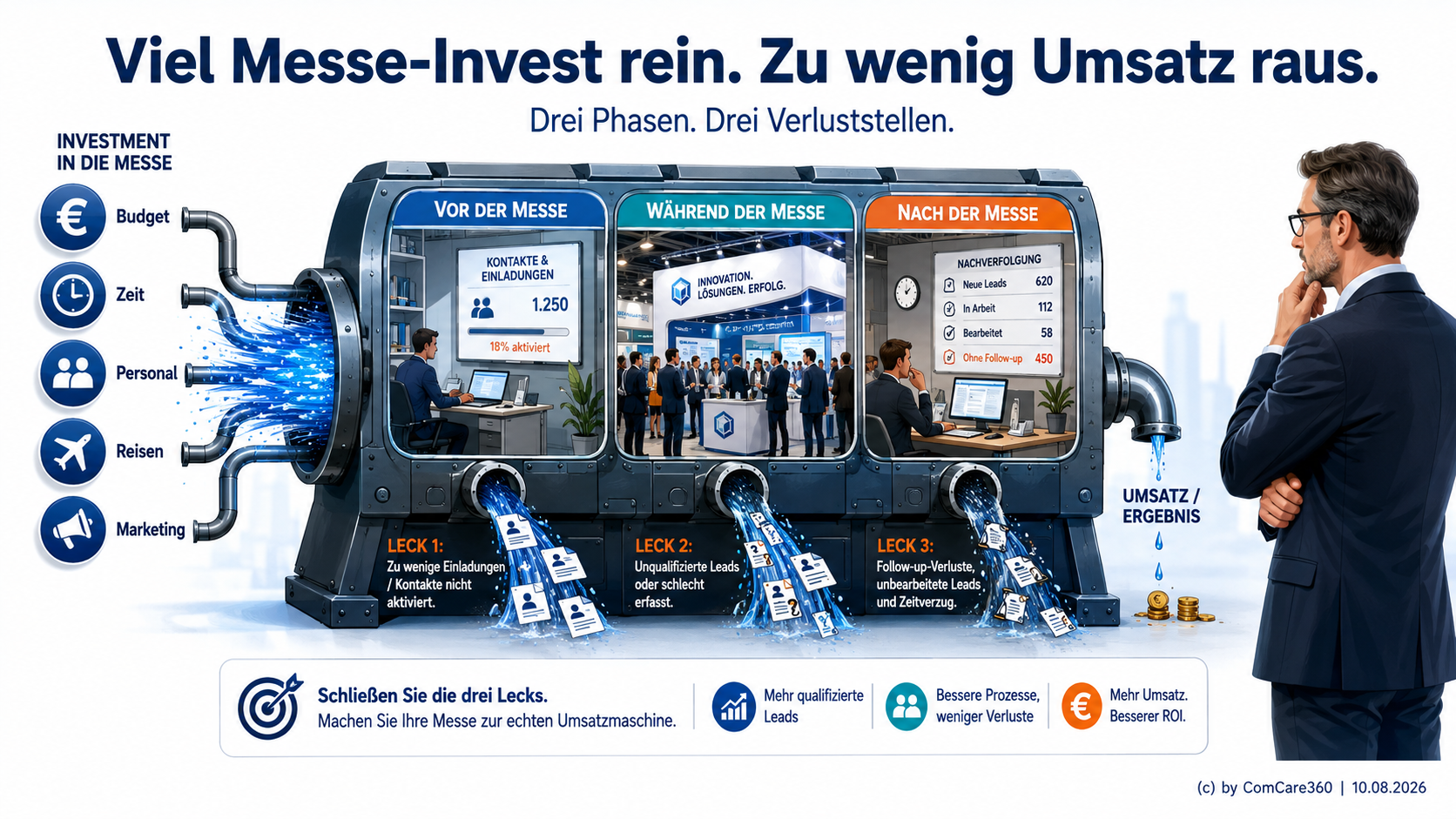
A lot of trade fair investment in, too little turnover out: three phases, three losses.
3. Before the trade fair: activate the market instead of waiting
If you wait for you to pass by the stand, you are giving away the most profitable phase. Before the trade fair, the relevant market can be activated in a targeted manner: multi-stage multichannel campaigns with VIP invitations, personal phone calls, e‑mail routes, reminders, social media and landing pages, as well as appointments, the reactivation of existing leads and the activation of existing customers, former customers and ongoing opportunities.
One thought that is often lost is particularly effective: It’s not just about actual trade fair visitors. The upcoming trade fair is an excellent conversation starter for your entire relevant network. If a prospective customer says “I’m not coming to the trade fair at all”, that’s not a no – then perhaps a team appointment or a personal sales meeting will arise instead. This is also a success of the trade fair campaign.
The claim is therefore clear: Activate A‑customers personally, address relevant B‑potentials, inform C‑contacts in a structured way, prioritize contacts and clarify responsibilities such as preparation time at an early stage.
But now, of all times, the marketing department is up to its ears busy with the trade fair stand – stand construction, graphics, exhibits, service providers, logistics, presentations, hotel, materials. And the sales department still has customers, offers, appointments and forecasts. On top of that, it is supposed to invite hundreds of contacts individually. This is not a question of will, but of capacity.
4. During the trade fair: not all full halls are the same
Many companies switch off communicatively as soon as the trade fair begins. But you can continue working right now: Address contacts again, remind invited VIPs, fill free call slots, activate contacts who have not yet appeared by phone or digitally, have social media and e‑mail paid into the ongoing trade fair operations.
And then there’s the quality of the leads. A badge scan is not a qualified lead. Neither is a business card. What is decisive is what is documented from the conversation.
Who is the human being – and what concerns him?
What specific needs are there?
How relevant is the opportunity?
What was agreed?
What happens next?
Who will take over – and until when?
This requires uniform conversation starts, digital contact recording, real-time transparency and a clear definition of the information that must be recorded.
The trade fair can also do more than produce leads. It brings customers, prospects, partners, experts and employees physically in one place for a short time – an enormous opportunity for content and trust: customer testimonials, short interviews, videos, photos, expert voices, questions from real customer conversations. Because people buy from people. Modern technology is not the opposite of this: the better documentation, sorting and enrichment work in the background, the more time there is for real conversations.
4. During the trade fair: not all full halls are the same
Many companies switch off communicatively as soon as the trade fair begins. But you can continue working right now: Address contacts again, remind invited VIPs, fill free call slots, activate contacts who have not yet appeared by phone or digitally, have social media and e‑mail paid into the ongoing trade fair operations.
And then there’s the quality of the leads. A badge scan is not a qualified lead. Neither is a business card. What is decisive is what is documented from the conversation.
Who is the human being – and what concerns him?
What specific needs are there?
How relevant is the opportunity?
What was agreed?
What happens next?
Who will take over – and until when?
This requires uniform conversation starts, digital contact recording, real-time transparency and a clear definition of the information that must be recorded.
The trade fair can also do more than produce leads. It brings customers, prospects, partners, experts and employees physically in one place for a short time – an enormous opportunity for content and trust: customer testimonials, short interviews, videos, photos, expert voices, questions from real customer conversations. Because people buy from people. Modern technology is not the opposite of this: the better documentation, sorting and enrichment work in the background, the more time there is for real conversations.
5. The technological bracket: CRM, automation, integrated AI
A professional trade fair process needs a strong CRM and marketing/sales system as the backbone. But a CRM can’t be a data graveyard. It is not enough to upload a few new data sets at some point after the trade fair. The system should already know in advance who is a customer and who is a prospect, where an ongoing opportunity exists, who has already been contacted and what interests are known. During and after the fair, new information must flow directly into this picture.
And this is exactly where AI becomes interesting – not as a copy-and-paste exercise with an open chat window, but deeply integrated into professional marketing, sales and CRM solutions. There, she helps structure and enrich data, segment contacts, support campaigns, prioritize leads, summarize conversation content, and trigger follow-up activities faster.
The goal always remains the same: more valuable time from person to person. Technology shouldn’t push people out of the sales process, but rather relieve them of the work for which you don’t need a human – so that there is more time for the work for which you absolutely need people.
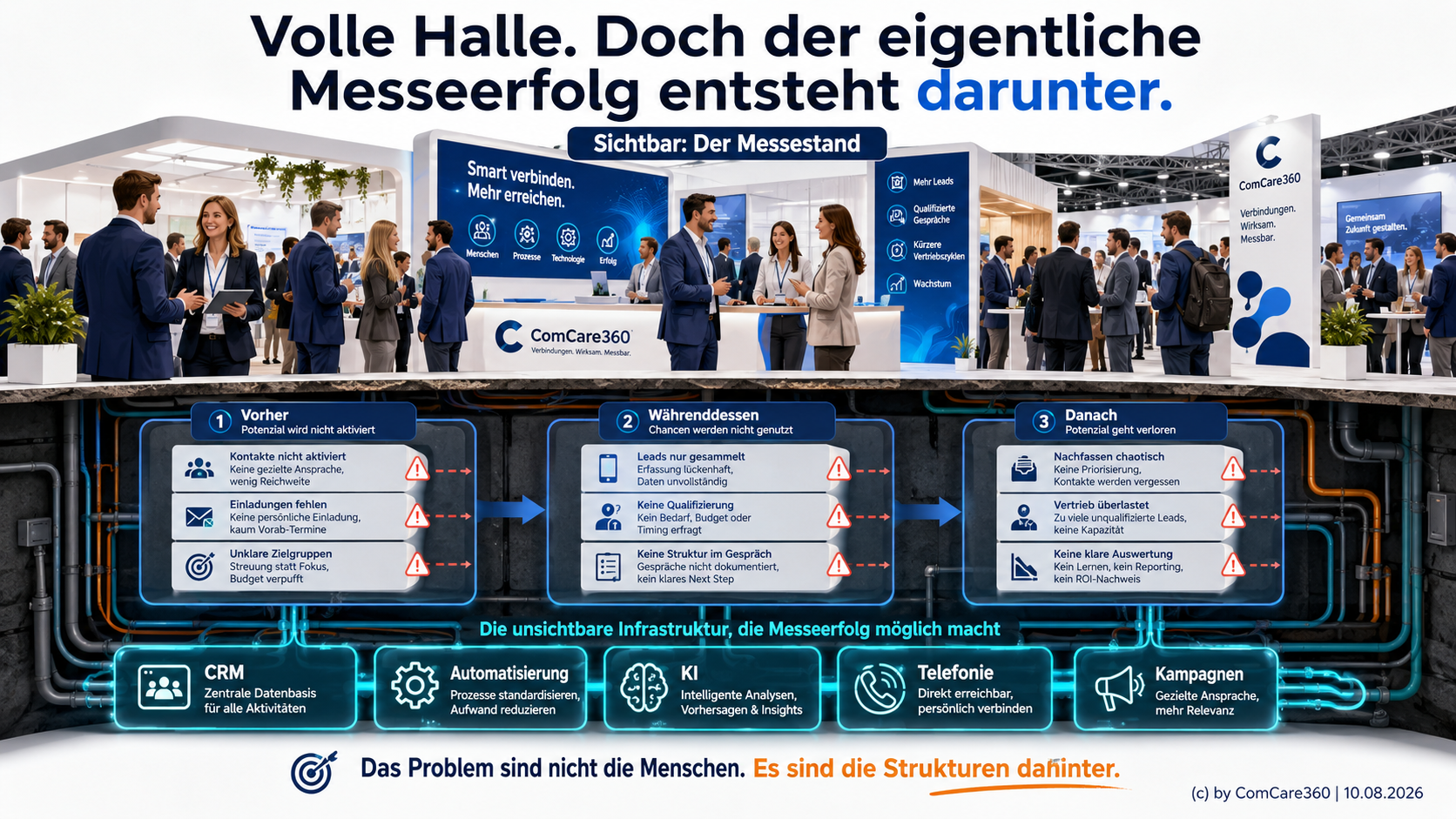
The trade fair stand is visible. The infrastructure underneath is decisive.
6. After the trade fair: this is where it is decided whether contacts become sales
Follow-up remains the Achilles’ heel. Because now, figuratively speaking, there are two piles in sales: the day-to-day business that was left behind during the trade fair – and the new leads, which would have to be processed particularly quickly right now.
In addition, there is the human factor. Trade fairs are exhausting: travel, long days, hundreds of conversations, evening events, little relaxation. Relying on sales to “really step on the gas” afterwards is not a strategy. This is not a sales problem, but a structural capacity conflict.
The consequence: the follow-up is prepared before the trade fair. How quickly is it followed up? Is there an automated or semi-automated follow-up? Which contacts are handled personally? Is there transparency about all trade fair contacts? And is sufficient capacity planned at all? Telephone follow-up, qualification, appointments, multi-stage follow-up campaigns, the processing of B and C potentials as well as clean CRM documentation can be planned – provided you plan them.
If you already think about the follow-up in the campaign planning, you determine in advance which contact will be called personally within 48 hours, which will run into an automated route and which will initially only be informed. This sorting costs an hour of coordination before the trade fair – and then decides on a significant part of the result.
7. The foundation under all three phases
The three phases only work if a few basic questions have been answered beforehand: What is the goal of the trade fair? How do we prioritize? What exactly is a qualified lead for us? Do sales, marketing and management have the same expectations? Who is responsible for what? If no one can clearly say internally what should come out of this trade fair, it will be difficult to measure performance afterwards.
“We had 437 leads.”
- How many relevant conversations, appointments, opportunities?
- How much pipeline, how much revenue?
- Which target groups reacted, which campaigns worked, which contacts developed?
- And what do we learn from this for the next trade fair?
Only then does trade fair activity become a controllable sales process.
7. The foundation under all three phases
The three phases only work if a few basic questions have been answered beforehand: What is the goal of the trade fair? How do we prioritize? What exactly is a qualified lead for us? Do sales, marketing and management have the same expectations? Who is responsible for what? If no one can clearly say internally what should come out of this trade fair, it will be difficult to measure performance afterwards.
“We had 437 leads.”
- How many relevant conversations, appointments, opportunities?
- How much pipeline, how much revenue?
- Which target groups reacted, which campaigns worked, which contacts developed?
- And what do we learn from this for the next trade fair?
Only then does trade fair activity become a controllable sales process.
8. The question that remains in the end: Who should implement this?
At this point, most decision-makers think two things at the same time: “There is actually more to it in many places.” And: “But who is going to implement all this in our country?” That’s exactly the point. Employees are often already working at the limit – additional activities fail not because of skill, but because of capacity.
This is exactly where ComCare360 brings additional operational clout to the trade fair process – before, during and after the trade fair: with people, multichannel campaigns, telephony, CRM, automation and integrated AI. Not technology instead of people. Not externally instead of internally. Instead, the right people are doing the right things, supported by the right processes and technologies. Internal sales work where their expertise makes the biggest difference – not every lead needs a highly-paid sales rep right away.
9. Conclusion
The difference between an expensive trade fair and a profitable trade fair is rarely the stand, the hall or the commitment of the team. It lies in the structures before, next to it and behind it: in activated contacts before the trade fair, in cleanly qualified discussions during the trade fair and in a prepared, quick follow-up afterwards. If you plan these three phases as one cohesive campaign and underpin them with data, processes and sufficient capacity, you will get much more impact out of the same budget. The problem is not the people. It’s the structures behind it – and you can change them.
And now the crucial question: How ready is your trade fair really?
They invest in stand space, stand construction, travel, staff and several days of valuable working time.
But how professionally do you actually make all the adjustments before, during and after the trade fair?
- Are the right customers and prospects activated at an early stage?
- Are you consistently exploiting the potential during the ongoing trade fair?
- Are leads recorded and qualified in a structured way?
- Are CRM, data, and processes neatly connected?
- Are you using automation and integrated AI where they really give your team clout?
And above all:
Is it already ensured before the first day of the trade fair that good conversations after the trade fair will also result in real sales opportunities?
Find out.
With our free trade fair success readiness check, you can check your entire trade fair process:
before the fair. During the fair. After mass. And the structures behind it.
You can see at a glance where you are already professionally positioned – and where you can get significantly more impact and turnover out of your existing trade fair investment.
Request the free trade fair success readiness check now.No theory. Not a general trade fair guide. But a concrete check of your own trade fair readiness.

Ingo Marggraf, Geschäftsführer der ComCare 360 GmbH, ist ein erfahrener Experte im Bereich Marketing, Vertrieb, Telemarketing und CRM-Systemen. Mit seinem umfangreichen Wissen und seiner Leidenschaft für innovative Lösungen hilft er Unternehmen dabei, ihren Umsatz zu steigern und erfolgreich zu wachsen.
Ingo Marggraf, Managing Director of ComCare 360 GmbH, is an experienced expert in the fields of marketing, sales, telemarketing and CRM systems. With his extensive knowledge and passion for innovative solutions, he helps companies increase their turnover and grow successfully.