

The request is just the tip of the iceberg: Long before your sales department comes into play, digital research, customer testimonials, references, and AI will determine whether your company will even end up on the shortlist. Because this process remains invisible, a blind spot is created that threatens their existence – and many only notice it when the requests fail to materialize.
The change in shopping behaviour has long since ceased to be a pure B2C phenomenon. In B2B , too, decision-makers, specialist departments and purchasing now conduct independent research, compare providers digitally and are increasingly supported by AI systems in the pre-selection process – long before personal contact is established. As a result, your company can exit the procurement process before your sales department even learns about an inquiry. This article shows why the inquiry is just the tip of the iceberg, how AI is accelerating this change, and why the invisible part of the purchasing process is becoming a blind spot – and how to recognize it and actively use it for your future.
⏱️ Reading time: approx. 6 minutesMany companies are wondering why fewer and fewer inquiries are coming in. Then sales activities are increased, campaigns are launched or processes are optimized. But the actual cause often lies much earlier.
Before a potential customer makes contact, an extensive selection process has long been underway – usually completely invisible to the provider. Decision-makers, specialist departments and purchasing conduct independent research, compare solutions, check references and are increasingly being supported by AI systems in pre-selection.
What sales sees in the end is just the tip of the iceberg: the few companies that have made it through this process and are actually approached. Everyone else may never know that they have already been sorted out.
This is precisely the blind spot that threatens the existence of many companies: they evaluate their sales on the basis of visible inquiries, conversations and offers. What they don’t see are all the potential customers for whom they were not found before, not correctly classified or not rated as trustworthy enough.
As long as companies do not recognize this blind spot, they can neither prepare for the change nor protect themselves from it. They react to the visible symptoms, while the actual cause continues to have an effect below the surface.
This blind spot can lead companies to ruin if they ignore it and continue to strengthen their previous measures without recognizing the true cause. But it can also become a great opportunity for the future: If you understand how the new B2B purchasing process really works, you can become visible, relevant and convincing exactly where decisions are increasingly being prepared today.
The big mistake: This only applies to B2C
When it comes to changing buying behavior, many people first think of online shops, comparison portals, Google reviews or social media – an image clearly assigned to B2C. In B2B, according to the widespread assumption, different laws continue to apply: personal relationships, recommendations, tenders, trade fairs and a sales department that knows the customers for years.
However, this separation no longer works. The people who decide on investments in B2B have long been accustomed to digital research, evaluations and quick comparisons in their private lives – and do not shed these habits as soon as they enter the office. They are increasingly transferring it to their professional decisions.
Personal relationships remain important and are often decisive in the end. However, the decisive factor is when they come into play: no longer at the beginning, but often only after an extensive digital pre-selection. If you don’t show up at this early stage, you won’t even be eligible for a personal interview.
What e‑commerce teaches us about underestimation
Technological upheavals were almost always underestimated in the beginning. The Internet and e‑commerce were also considered temporary phenomena for a long time. The result is well known: entire industries and distribution channels have been fundamentally changed. Companies that reacted too late lost market share or disappeared – while at the same time new markets and some of today’s largest corporations emerged, from Amazon to Google and Meta to Alibaba, Salesforce or Shopify.
The decisive factor was never the technology alone, but its effect on people’s behavior – on how they search, compare, decide and buy. It is precisely at such a threshold that we stand again today. This time, the development is being further accelerated by artificial intelligence, at a pace that significantly exceeds previous upheavals.
The invisible part of the purchasing process
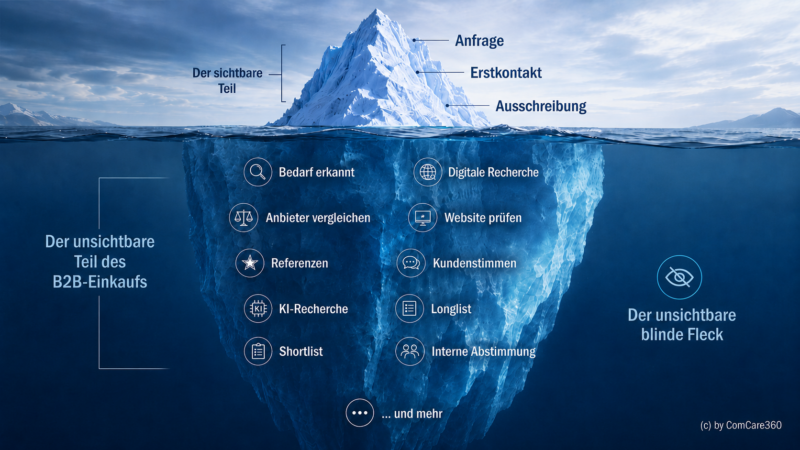
This is where the image of the iceberg helps. Above the surface of the water, the provider sees what he has always seen: the inquiry, the initial meeting, a tender or the invitation to submit an offer. The thinking of many sales organizations is based on this visible top.
Beneath the surface, however, a lot has already happened at this point: a need has been identified, information has been collected, solutions have been examined, providers have been researched and compared, websites, references and customer testimonials have been evaluated. This resulted in a longlist and finally a much smaller shortlist. Only then are individual providers contacted at all.
Many participants, many perspectives
B2B purchasing decisions are rarely made by a single person. Depending on the scope, management, specialist departments, purchasing, IT, data protection, controlling, future users and external consultants can be involved. Each role looks at a vendor from a different perspective and asks different questions.
Specialist Department
Looks for the best technical solution for the specific problem.
Purchasing
Assesses comparability, prices and risks.
IT
Pay attention to security and integration capability.
Management
Asks about benefits and cost-effectiveness.
Later users
Search for the experiences of other users.
These perspectives give rise to numerous digital contact points and evaluation situations that traditional sales often do not even know about and can only influence to a limited extent.
This digitalization is not new: supplier portals, electronic tenders, ERP systems and e‑procurement platforms have long since standardized procurement and made it more data-based. Artificial intelligence now forms the next stage – and intervenes at the core of the decision: in the research, evaluation, selection and recommendation of providers.
Many participants, many perspectives
B2B purchasing decisions are rarely made by a single person. Depending on the scope, management, specialist departments, purchasing, IT, data protection, controlling, future users and external consultants can be involved. Each role looks at a vendor from a different perspective and asks different questions.
Specialist Department
Looks for the best technical solution for the specific problem.
Purchasing
Assesses comparability, prices and risks.
IT
Pay attention to security and integration capability.
Management
Asks about benefits and cost-effectiveness.
Later users
Search for the experiences of other users.
These perspectives give rise to numerous digital contact points and evaluation situations that traditional sales often do not even know about and can only influence to a limited extent.
This digitalization is not new: supplier portals, electronic tenders, ERP systems and e‑procurement platforms have long since standardized procurement and made it more data-based. Artificial intelligence now forms the next stage – and intervenes at the core of the decision: in the research, evaluation, selection and recommendation of providers.
AI becomes a shopping assistant
This development is not a vision for a distant decade, but is already taking place today. AI systems research providers for a specific task, structure requirements, compare solutions, create provider lists, evaluate references and compare advantages and disadvantages. You can also prepare questions for vendor appointments and draft decision templates.
With so-called AI agents, this process is automated even more. In the future, such systems will search for suitable providers more and more independently, check them on the basis of defined criteria and ultimately recommend only a small, pre-filtered selection. The human then no longer decides from the entire market, but from what the AI presents to him.
Why trust and references are decisive
The more complex a product or service is, the more difficult it is to assess before buying it – and the more important credible evidence becomes. General advertising statements tend to generate skepticism in B2B. Decision-makers want to know specifically what problems a provider has already solved and what experiences other customers have had. Case studies, reference reports, evaluations and comprehensible results reduce uncertainty and create trust.
One point that is often overlooked is crucial: it is no longer just about the effect on people. Visible, clearly structured customer experiences also help search engines and AI systems to correctly classify a provider and include it in recommendations. Good work alone is therefore no longer enough – the positive experiences of your customers must also be visible and findable, otherwise they simply do not exist at the decisive moment.
Why declining inquiries are misinterpreted
If the number of inquiries decreases, the most common reaction is to ramp up visible sales: more cold calling, additional campaigns, higher advertising budgets, new tools, stricter targets. All of this can be useful in individual cases. However, these measures do not solve the real problem if a company falls out of the selection before the first contact. You can’t win an offer you’ve never been invited to.
The blind spot: danger and opportunity at the same time
The blind spot is that many companies simply don’t see the crucial part of the process. They don’t know which searches they don’t even show up on, which topics they are misclassified on, or what information potential customers are missing. Nor do they know why competitors are recommended more often, what doubts prospects develop, how many shortlists they are already missing from, and how search engines and AI systems describe their company.
If this blind spot persists, the consequences will be noticeable: fewer enquiries, rising acquisition costs, growing price pressure and a creeping loss of market share. The tricky thing about this is that this development goes unnoticed for a long time – until it can no longer be overlooked in the figures.
However, this is precisely where the opportunity lies. Companies that uncover their blind spot can sharpen their positioning, build relevant content, systematically use customer voices and make trust visible – for humans, search engines and AI. They become findable and compelling where decisions are being prepared, and gain an edge over competitors who continue to underestimate change.
The wave is already here
It would be convenient to dismiss this development as a future scenario. But the wave is no longer coming – it is already here, in the middle of ongoing procurement processes in which providers are already being found or not being found. What makes it so powerful is the speed of AI development: technical possibilities and user behavior change in parallel and reinforce each other. Humans get used to using AI for research, comparisons and decisions surprisingly quickly.
For companies, this means a clear crossroads: they can ignore the development until it overwhelms them – or learn to use the wave and thus position themselves for the future. The urgency is real, not as scaremongering, but as a sober statement: the period in which a head start is still easy to work out is getting smaller with every month.
Self-check: Do you know your blind spot?
Before you read on, take a moment and honestly check how well you know the invisible part of your own shopping process. Do you know how potential customers are looking for solutions like yours today – and whether your company even appears in this research? Is it clear which problems you are solving for which target groups, and do you have visible, credible customer voices and concrete references? Can search engines and AI systems correctly classify your offer, and do you know how to describe and recommend your business? Finally, do you know the reasons why prospects don’t ask you – and do you have a systematic process for understanding and leveraging customer experiences?
The more often you hesitate to ask these questions, the greater the likelihood that your blind spot is already having an effect – and at the same time, the greater the potential you can leverage.
The decisive question for your future
The decisive question is therefore no longer just: How well does your sales department sell? It is: Will your company still be found, correctly classified and recommended as a trustworthy provider in the new B2B purchasing process? And more importantly, do you know your own blind spot – or are you already losing potential customers without even realizing it?
This is exactly what we should be talking about. We have now developed extremely powerful solutions with which companies can uncover their blind spot and strengthen their digital visibility, their customer voices and their relevance for people, search engines and AI systems in a targeted manner – from strategic analysis to concrete implementation.
The blind spot can become an existential threat – but it can also be exactly the opportunity that will lead your company safely and successfully into the future. What are you waiting for? The change is already here – and due to the rapid development of AI, there is less and less time to prepare for and protect it.

Ingo Marggraf, Geschäftsführer der ComCare 360 GmbH, ist ein erfahrener Experte im Bereich Marketing, Vertrieb, Telemarketing und CRM-Systemen. Mit seinem umfangreichen Wissen und seiner Leidenschaft für innovative Lösungen hilft er Unternehmen dabei, ihren Umsatz zu steigern und erfolgreich zu wachsen.
Ingo Marggraf, Managing Director of ComCare 360 GmbH, is an experienced expert in the fields of marketing, sales, telemarketing and CRM systems. With his extensive knowledge and passion for innovative solutions, he helps companies increase their turnover and grow successfully.