

New leads remain important. But those who complain about falling margins, buy expensive new contacts and at the same time cut costs without a customer’s point of view often start at the wrong end.
Many companies increase their budget for new leads and reduce costs at the same time – both without looking at the customers they already have. As a result, money is left on two sides: possible additional sales are not realized, unnecessary costs continue to run. This is exactly where a systematic customer penetration campaign comes in. It taps into additional needs, recognizes termination risks at an early stage, gains recommendations and public evaluations, and uncovers services that customers no longer need. The article shows how a single customer conversation serves five economic levers at the same time – and what such a campaign needs operationally.
⏱️ Reading time: approx. 7 minutes1. The most expensive mistake in sales
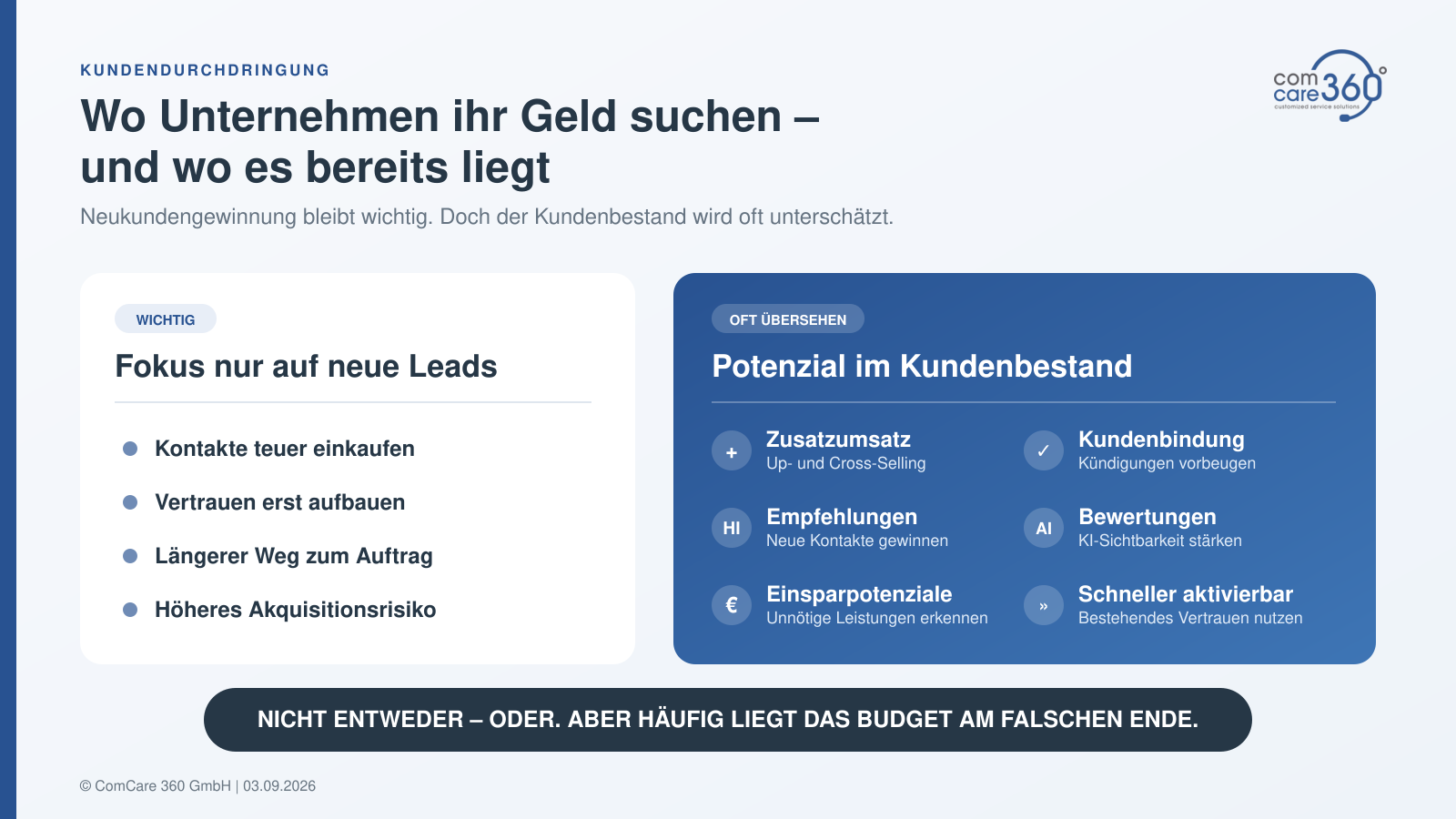
Hardly any sentence is heard as often in sales meetings as this one: “We need more leads.” Margins are falling, competition is getting tougher, so the budget for addresses, campaigns and acquisition measures is increasing. At the same time, many companies are running a second program: reducing costs. Both decisions are surprisingly often made without a single glance at the customers who have already been acquired.
The result is a double loss. On the revenue side, needs remain undetected because no one asks. Up- and cross-selling potentials are not realized because they are not recorded in a structured way. Termination risks only become visible when the termination is in-house. Recommendations are not requested, reviews are not collected. On the cost side, services, processes and contact channels continue at the same time that customers no longer need or want – financed from a budget that is lacking elsewhere.
In this situation, those who invest exclusively in new contacts are buying expensively what is already available in their own inventory: access, experience and trust.
The effect is paradoxical. For an unknown contact, address costs, campaign budgets and sales time are used without any need, budget or responsibility being secured. For the existing customer, all these questions have long since been answered – but no one asks them a second time. In many companies, there is a period of several years between the last deal and the last substantive discussion about the cooperation.
2. Not either – or: Where your next euro will have an impact
So that there is no misunderstanding: New customer acquisition is not the problem. No company grows permanently without new customers, and lead generation remains a necessary discipline. The mistake lies in the one-sidedness. Companies need new customer acquisition and existing customer development. It becomes problematic when more and more money flows into new contacts, while the existing customer base is not systematically developed.
Sometimes the greater leverage lies in the acquisition of new customers, sometimes in customer penetration. Often the intelligent combination of both is right. Therefore, it is not the fundamental question that is decisive, but the calculation in the individual case: Where do time, budget and resources currently achieve the greatest economic effect?
A new contact must first be found, qualified, convinced and established. An existing customer knows your services, your processes and your contact persons. The path to the next order is shorter, the acquisition risk lower, the lead time shorter. It is precisely this difference that is regularly underestimated in budget planning.
The question is not whether you should invest in leads. It is how your sales budget is divided between two portfolios whose returns differ significantly – and whether this distribution is deliberately decided or has grown historically.
3. What Customer Penetration Really Means
Customer penetration doesn’t mean selling more to existing customers indiscriminately. A campaign that only focuses on its own revenue plan will be immediately recognized as such by customers – and harm the relationship they actually wanted to use.
From the customer’s perspective, it’s about something else: understanding how the customer’s situation has changed since the last deal. What new tasks have been added? What needs have not yet been met? Which additional services actually fit, and which don’t? Where do frictions, dissatisfaction or the first signs of churn arise?
If you ask these questions systematically, you can tap into up- and cross-sell potential in a customer-oriented way, identify problems at an early stage, prevent terminations and further develop the customer relationship in the long term. A good customer penetration campaign thus combines growth and customer loyalty – and not one at the expense of the other.
The difference between opportunity and system is crucial. Almost every company knows cases in which a customer conversation has led to an additional order by chance. These cases are not a sales process, but luck. Systematics means: defined customer segments, a uniform conversation guideline, documented results, clear responsibilities for follow-up and an evaluation that goes beyond the individual customer.
4. The quality call: listen before selling
The personal quality call is a strong entry point into a customer penetration campaign. It does not sell immediately. First of all, it is a matter of listening to the customer and reflecting on the cooperation together.
Tried-and-tested questions for the interview guide can be arranged in two directions: Where does additional value arise – and where does unnecessary effort arise?
These conversations create concrete sales opportunities. At the same time, companies receive valid customer information for better cost, performance and resource decisions. A single call thus provides insights for which workshops and analyses are scheduled elsewhere.
4. The quality call: listen before selling
The personal quality call is a strong entry point into a customer penetration campaign. It does not sell immediately. First of all, it is a matter of listening to the customer and reflecting on the cooperation together.
Tried-and-tested questions for the interview guide can be arranged in two directions: Where does additional value arise – and where does unnecessary effort arise?
These conversations create concrete sales opportunities. At the same time, companies receive valid customer information for better cost, performance and resource decisions. A single call thus provides insights for which workshops and analyses are scheduled elsewhere.
5. One conversation, five economic levers
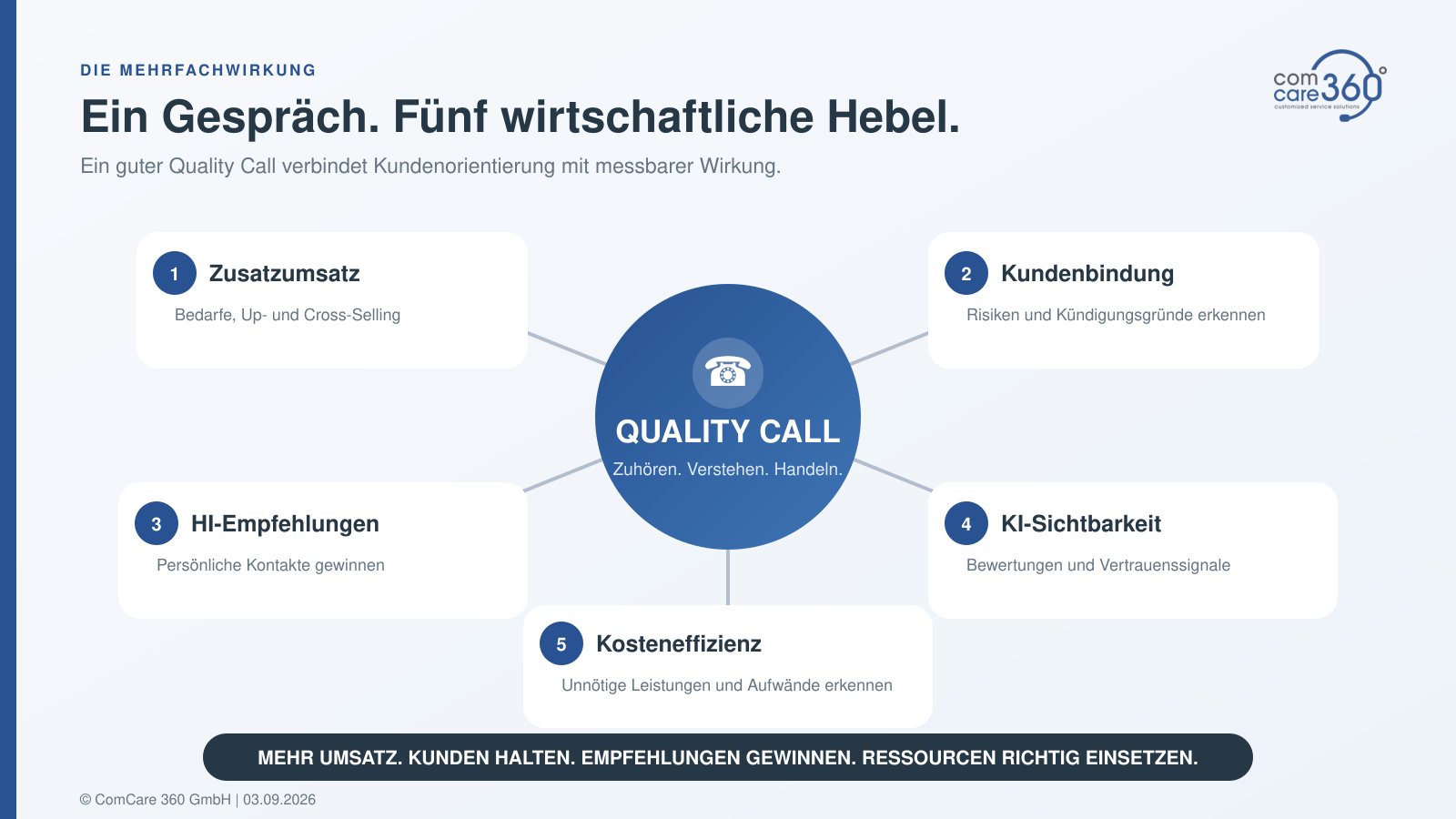
The economic appeal of a quality call lies in its multiple effects. A single well-conducted conversation operates five levers at the same time.
Additional sales
Additional needs are identified before they end up with the competition. Up-selling, cross-selling and the placement of other suitable products and services are based on a conversation – not on the basis of a guess. It often turns out that customers do not know parts of their own service portfolio at all. What seems self-evident internally has never reached the customer.
Customer loyalty
Dissatisfaction rarely manifests itself in a formal complaint, but in subordinate clauses. Those who listen identify termination risks at an early stage, solve problems before customers leave, and stabilize endangered relationships in a targeted manner. The economic value of this lever is often underestimated: a retained customer costs nothing in terms of new acquisition, secures recurring revenue and remains available as a reference.
HI recommendations
HI stands for Human Intelligence. Satisfied customers can be asked for personal recommendations: Who could also be interested in the offer? Which person or company could benefit from the service? Can the contact be approached with reference to the recommendation? This creates warm contacts with a personal leap of faith – much cheaper and faster than any cold address.
AI visibility and digital trust signals
Satisfied customers can also be asked for an authentic public review – depending on the company, for example in the Google company profile, on Trusted Shops, TripAdvisor or on LinkedIn.
The customer does not directly recommend the company to AI. It creates a publicly visible and machine-readable proof of trust that can be used by humans, search engines and AI systems to classify a company. This is just as relevant in B2C due to changed purchasing behavior as it is in B2B due to changed procurement behavior.
Cost-effectiveness
Customers are not only asked what else they need. Equally important is the question of what they no longer need or want. This allows companies to recognize which services are hardly used anymore, which processes cause unnecessary effort, which offers can be simplified, which contact channels are no longer relevant, where resources are incorrectly distributed – and which services really inspire from the customer’s point of view.
Costs are not cut blindly or exclusively from an internal point of view. The customer perspective creates a sound basis for decision-making. It is important to note that cost efficiency must not be reflexively equated with staff reductions. The focus is on better prioritization, less waste, clearer services, more sensible automation and a more targeted use of resources.
6. From listening to impact
Customer testimonials must not only be collected. The economic effect only arises when findings are translated into concrete sales, service, performance and cost measures. The underlying logic is a cycle.
In practice, this cycle usually fails at the same point: the conversations take place, the results end up in notes – and no one is responsible for deriving measures from them and measuring their impact. Anyone who organizes this transition turns a survey into a control instrument.
This does not require a large structure, but clear definitions: Who evaluates the results of the discussions? At what rhythm? Which findings go to sales, which to service, and which to performance and cost planning? And how will you know in three months whether the derived measures have worked?
6. From listening to impact
Customer testimonials must not only be collected. The economic effect only arises when findings are translated into concrete sales, service, performance and cost measures. The underlying logic is a cycle.
In practice, this cycle usually fails at the same point: the conversations take place, the results end up in notes – and no one is responsible for deriving measures from them and measuring their impact. Anyone who organizes this transition turns a survey into a control instrument.
This does not require a large structure, but clear definitions: Who evaluates the results of the discussions? At what rhythm? Which findings go to sales, which to service, and which to performance and cost planning? And how will you know in three months whether the derived measures have worked?
7. What a customer penetration campaign needs operationally
In order for the idea to become a resilient process, four things are needed: a clean database, a customer-oriented conversation starter, consistent operational implementation and a structured evaluation.
A CRM like HubSpot forms the basis – for structured customer data, segmentation, campaign management, the documentation of conversations, the tracking of opportunities and the handover to sales, marketing or service. Without this basis, insights remain isolated cases.
Structured customer surveys record needs, satisfaction, potential for improvement, new requirements, termination risks as well as unnecessary services and expenses in a comparable form. The Quality Call complements them with the personal dimension that no questionnaire provides.
Telesales, qualification and scheduling ensure implementation: reaching the right contact persons, qualifying needs, concretizing interests, making appointments, documenting results and consistently pursuing identified opportunities. E‑mail marketing accompanies the process, announces discussions, creates opportunities for discussion and provides information later.
At the end of the process, there is an evaluation – on two levels. At the customer level, concrete tasks arise: an offer, an appointment, a clarification, a recommendation. At the portfolio level, a picture emerges of which services are contributing, which segments have potential, where risks arise and where effort is incurred without customer benefit. This second level is the actual management benefit of a customer penetration campaign.
8. In brief: reactivation and product launch
Customer reactivation campaigns are the sister of customer penetration: While customer penetration develops active relationships, reactivation revives dormant or lost relationships. Both follow a similar logic, but address different audiences.
New product launches can also be combined very well with a customer penetration campaign. Existing customers are often an obvious target group – as long as the supply and actual need match. We address both topics in our own articles.
9. Conclusion: Where will your next euro have the greatest impact?
You don’t have to choose between new customer acquisition and existing customer development. You need to know where your time, budget and resources are currently achieving the greatest economic effect.
Together with you, we develop and implement a targeted customer penetration campaign – from the selection and segmentation of your customers to the conversation guide to personal quality calls and systematic evaluation.
Here’s how to learn:
- where additional needs and concrete sales potential lie,
- which customer relationships are at risk,
- what personal recommendations and public reviews you can gain,
- which services really inspire your customers,
- and which offers, processes or efforts they no longer need.
This creates a well-founded basis for decision-making for more sales, stronger customer loyalty and targeted cost savings from the customer’s point of view.
Let’s find out together how much untapped potential there is in your customer base. Request a campaign meeting now

Ingo Marggraf, Geschäftsführer der ComCare 360 GmbH, ist ein erfahrener Experte im Bereich Marketing, Vertrieb, Telemarketing und CRM-Systemen. Mit seinem umfangreichen Wissen und seiner Leidenschaft für innovative Lösungen hilft er Unternehmen dabei, ihren Umsatz zu steigern und erfolgreich zu wachsen.
Ingo Marggraf, Managing Director of ComCare 360 GmbH, is an experienced expert in the fields of marketing, sales, telemarketing and CRM systems. With his extensive knowledge and passion for innovative solutions, he helps companies increase their turnover and grow successfully.