

How customer voices become management information – for lower costs, more targeted use of resources and additional revenue from inventory.
Profit = turnover – costs. As simple as the equation sounds, it is difficult to implement in practice today – and even more so in the next few years. So before you have a long internal discussion about where to save, invest or sell more: Ask those who will pay for it in the end – your customers. A professionally designed customer survey can reveal an astonishing amount about where costs can be reduced, resources can be used in a more targeted manner and additional sales potential can be leveraged – and in the best case, sales can be generated directly in the conversation.
⏱️ Reading time: approx. 7 minutesProfit = turnover – costs: simple formula, difficult practice
Hardly any other business formula is so short and so undisputed. And hardly any other is so difficult to resolve in practice – especially at a time when budgets are tightening, markets are becoming more volatile and customer expectations are becoming more demanding. Because behind the equation are two sets of questions that are dealt with in parallel and usually under time pressure in most companies.
Costs down
- What can we save or simplify?
- What services can we reduce?
- Where can resources be used differently?
- Which activities may have little effect?
Turnover high
- Where are there untapped needs?
- What potential lies in the existing customer business?
- Which customers can be reactivated?
- Where do cross-sell and upsell opportunities arise?
These lists are quickly created. Answering them is more difficult. This is because every single question contains an assumption about what customers actually use, what they appreciate, what they miss – and what they would be willing to pay extra for.
Profit = turnover – costs: simple formula, difficult practice
Hardly any other business formula is so short and so undisputed. And hardly any other is so difficult to resolve in practice – especially at a time when budgets are tightening, markets are becoming more volatile and customer expectations are becoming more demanding. Because behind the equation are two sets of questions that are dealt with in parallel and usually under time pressure in most companies.
Costs down
- What can we save or simplify?
- What services can we reduce?
- Where can resources be used differently?
- Which activities may have little effect?
Turnover high
- Where are there untapped needs?
- What potential lies in the existing customer business?
- Which customers can be reactivated?
- Where do cross-sell and upsell opportunities arise?
These lists are quickly created. Answering them is more difficult. This is because every single question contains an assumption about what customers actually use, what they appreciate, what they miss – and what they would be willing to pay extra for.
The blind spot: We almost always discuss this internally
Take a look at where these questions are actually discussed in your company. In the management meeting. In the sales jour fixe. In the budget round. In the quality circle. Management, sales, marketing, service and controlling evaluate from the inside what could be important for customers.
That’s not wrong. It’s just incomplete – and it carries a risk.
A customer survey does not replace any of these internal perspectives. It complements them with the one that is systematically missing in decision-making rounds: figures, strategy and operational experience plus customer perspective. Only this combination creates a more complete picture.
And this image has an effect in many more places than the term “customer survey” initially suggests.
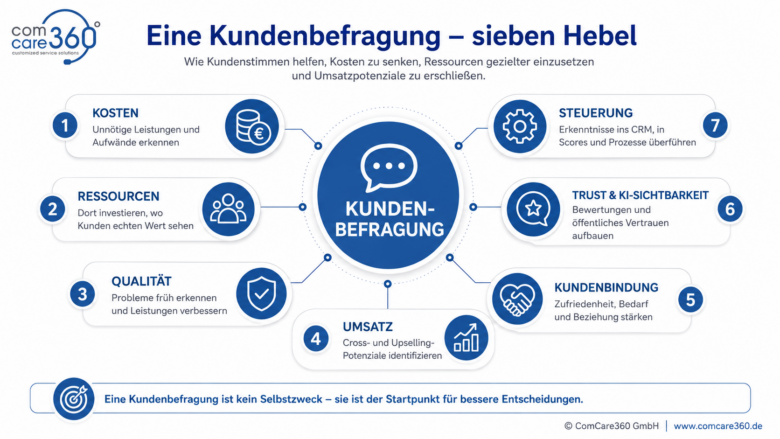
A customer survey – seven levers: costs, resources, quality, revenue, customer loyalty, trust & AI visibility, management
Three questions that reveal more than any satisfaction grade
“How satisfied are you with us?” is a legitimate question. It provides a number, and numbers can be compared, displayed in dashboards and tracked over years. They are rarely an instruction for action. For the management of a company, three other questions are much more productive.
Omit
What costs us resources but creates hardly perceived value for the customer?
Services are hardly used, certain additional services are not valued, internal processes cause effort without increasing customer benefits – and some things simply continue out of tradition.
Goal: Reduce costs without destroying relevant customer value.
Improve
What is important to customers but not yet working well enough?
Critical contact points, poor accessibility, unnecessary waiting times, quality problems, communication gaps, complicated processes.
The goal: to use resources in a more targeted manner where they actually have an impact from the customer’s point of view.
Expand
Where is there additional demand?
Supplementary services, additional consulting needs, new requirements, concrete cross-selling and upselling approaches.
The goal: not simply sell more, but generate additional sales where there is actually a customer need.
If you ask these three questions seriously, you will not receive a satisfaction grade at the end, but a list of priorities.
Three questions that reveal more than any satisfaction grade
“How satisfied are you with us?” is a legitimate question. It provides a number, and numbers can be compared, displayed in dashboards and tracked over years. They are rarely an instruction for action. For the management of a company, three other questions are much more productive.
Omit
What costs us resources but creates hardly perceived value for the customer?
Services are hardly used, certain additional services are not valued, internal processes cause effort without increasing customer benefits – and some things simply continue out of tradition.
Goal: Reduce costs without destroying relevant customer value.
Improve
What is important to customers but not yet working well enough?
Critical contact points, poor accessibility, unnecessary waiting times, quality problems, communication gaps, complicated processes.
The goal: to use resources in a more targeted manner where they actually have an impact from the customer’s point of view.
Expand
Where is there additional demand?
Supplementary services, additional consulting needs, new requirements, concrete cross-selling and upselling approaches.
The goal: not simply sell more, but generate additional sales where there is actually a customer need.
If you ask these three questions seriously, you will not receive a satisfaction grade at the end, but a list of priorities.
When Listening Becomes Revenue
One aspect is almost always lost in the discussion about customer surveys: A survey is not just a question, answer and evaluation. It is a qualified conversation with a customer who is thinking about what is important to him at that moment. It is precisely in these conversations that additional needs, concrete inquiries, cross- and upselling opportunities, appointments are made, reactivation options and new projects regularly arise.
However, there is one condition: the survey must not become a disguised sales pitch. Customers notice this immediately, and the loss of trust weighs more heavily than any short-term deal. The decisive factor is the sequence – listening, understanding, recognizing needs, reacting sensibly. What emerges from this is sales from relevance. And experience has shown that this works much better than sales from campaign pressure.
Four forms of customer surveys – four effects
“Customer survey” sounds like a single format. In fact, there are several – with different goals and different effects.
Regular customer survey
For active existing customers, satisfaction, most important services, perceived benefits, potential for improvement, future requirements and willingness to recommend can be queried.
Impact: Customer retention, customer penetration, cross- and upselling, recommendations and reviews.
Reactivation survey
The group of customers with whom there has been no contact for a long time is particularly underestimated. It becomes visible why the contact fell asleep, whether there were problems and how requirements have changed.
Impact: Conversation starter without sales pressure – a survey becomes a customer reactivation campaign.
Quality Calls
A short conversation after projects, installations, service calls, deliveries, support cases or larger orders – especially effective when services are provided by third parties.
Impact: Quality assurance, early warning system for the actual provision of services, valuations and sales opportunities.
Strategic survey and market research
Which services will become more important in the future, which will lose importance? What should we simplify? Where do we invest resources without perceptible customer benefit?
Impact: Input for portfolio and investment decisions, product development and resource allocation.
Four forms of customer surveys – four effects
“Customer survey” sounds like a single format. In fact, there are several – with different goals and different effects.
Regular customer survey
For active existing customers, satisfaction, most important services, perceived benefits, potential for improvement, future requirements and willingness to recommend can be queried.
Impact: Customer retention, customer penetration, cross- and upselling, recommendations and reviews.
Reactivation survey
The group of customers with whom there has been no contact for a long time is particularly underestimated. It becomes visible why the contact fell asleep, whether there were problems and how requirements have changed.
Impact: Conversation starter without sales pressure – a survey becomes a customer reactivation campaign.
Quality Calls
A short conversation after projects, installations, service calls, deliveries, support cases or larger orders – especially effective when services are provided by third parties.
Impact: Quality assurance, early warning system for the actual provision of services, valuations and sales opportunities.
Strategic survey and market research
Which services will become more important in the future, which will lose importance? What should we simplify? Where do we invest resources without perceptible customer benefit?
Impact: Input for portfolio and investment decisions, product development and resource allocation.
Reviews, trust and digital visibility
If a customer says “I’m very satisfied” in a conversation, the process doesn’t have to end there. The obvious follow-up question is: Would they be willing to share this experience publicly – via Google, relevant industry platforms, review portals, as a reference or testimonial? A customer survey is associated with referral marketing, reputation and new customer acquisition.
And it touches on a development that is currently gaining in importance. Publicly visible customer experiences describe a company: quality of service, problem-solving skills, reliability. You should stay away from simplified promises – “many Google reviews automatically lead to better AI rankings” is not a reliable statement. Seriously, the more consistently a company’s website, company profiles, performance presentation and real, publicly visible customer experiences describe it, the stronger its digital basis of trust and relevance will be – even for AI-supported information and recommendation systems.
Incidentally, how a company is represented in AI-supported systems today can be analyzed – an AI visibility analysis shows what image is actually created there.
A survey becomes a process: the Customer Voice Flywheel
The actual impact is not created by the one-time survey. It is created by the cycle that arises from it: listening (customer surveys, market research, quality calls), recognizing (what is important, what doesn’t work, where needs arise, where resources are being wasted), deciding (what is reducing, what improving, what are expanding), activating (reactivation, cross- and upselling, quality measures), reinforcing (ratings, recommendations, reputation, AI visibility), systematizing (CRM, scores, tasks, workflows) and continuing to learn.
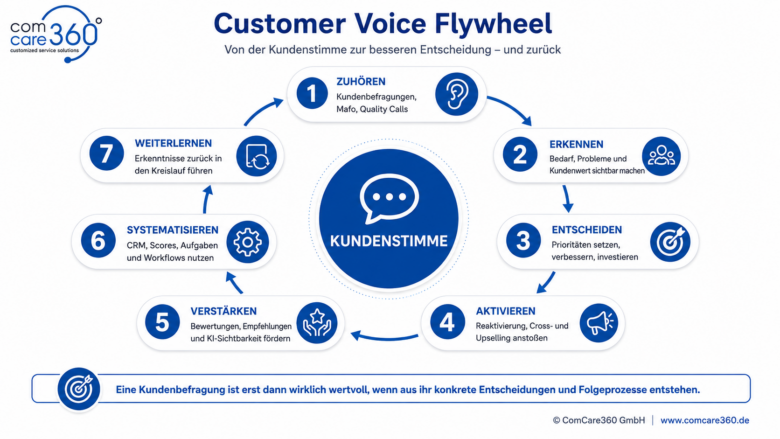
“Customer Voice Flywheel: From the Customer Voice to Better Decision-Making – and Back”
Each run makes the next more precise: You know better which customers you should address, which questions are worthwhile and which measures have actually worked. The customer survey is therefore not the goal. It is the starting point of a continuous improvement and growth process.
CRM instead of Excel: Insights become follow-up processes
A one-time survey can be organized with a list. A cycle cannot. If you want to work systematically, you need a database that brings together which customers are to be contacted, when the last contact took place, what statements were made, what problems are mentioned, where there are sales opportunities or reactivation potential – and what next task arises from this, for whom and by when. In a CRM system like HubSpot, this is standard functionality. This turns a survey into a controllable process.
Over time, scores are created: satisfaction, retention, reactivation potential, cross-selling opportunities, churn indicators, recommendation probability, quality indicators. And follow-up processes can be built on top of scores.
| Trigger | Follow-up process |
|---|---|
| Very satisfied customer | Request a review |
| Additional need identified | Sales task with deadline |
| Critical dissatisfaction | Escalation to service or management |
| for a long time | Reactivation process |
| Project completed | Quality Call |
| Recurring quality problem | Improvement measure in management |
In the future, individual steps of this process will increasingly be supported by AI agents: conversation preparation, prioritization of customers, call summaries, classification of answers, CRM updates, follow-up tasks. This is a question of efficiency, not a question of principle. The focus remains on the person and the customer’s voice – and the conversation in which it arises.
Conclusion
Sales up, costs down – the question remains correct. But in most companies, it is answered exclusively internally. Some of the answers have long been with their own customers. They know very well which services they appreciate, which they hardly perceive and what they lack today.
Therefore, don’t use the customer voice as a satisfaction thermometer, but as a basis for deciding where you can reduce costs, use resources more specifically and increase sales. And turn customer feedback into an end-to-end process – from insight to concrete action.
Maybe you should just ask your customers. We are happy to support you.
Where can costs be reduced? Where are resources used that have little effect on the customer? Where, on the other hand, is it worthwhile to invest more? And what additional sales opportunities may have long been in your customer base?
A professionally designed customer survey can provide surprisingly concrete answers to these questions – and in the best case, generate sales directly during the survey.
We support you in selecting the right customers, asking the right questions and actually making something out of the answers: from quality calls and reactivation to cross- and upselling to evaluations, AI visibility and systematic follow-up processes in CRM.
Let’s think together about what you should actually ask your customers today.

Ingo Marggraf, Geschäftsführer der ComCare 360 GmbH, ist ein erfahrener Experte im Bereich Marketing, Vertrieb, Telemarketing und CRM-Systemen. Mit seinem umfangreichen Wissen und seiner Leidenschaft für innovative Lösungen hilft er Unternehmen dabei, ihren Umsatz zu steigern und erfolgreich zu wachsen.
Ingo Marggraf, Managing Director of ComCare 360 GmbH, is an experienced expert in the fields of marketing, sales, telemarketing and CRM systems. With his extensive knowledge and passion for innovative solutions, he helps companies increase their turnover and grow successfully.