

Everyone is rediscovering the phone. Good sales teams had never put it down. Because LinkedIn and other social media create visibility – conversations create clarity. The listener is back, even though he was never gone.
The telephone is currently being celebrated as a new discovery on LinkedIn – although professional sales teams had never put the phone down. This post puts the debate in perspective: LinkedIn, content, email, AI, and automation create visibility and reach, but visibility alone is not sales. Only personal dialogue turns a data set into a qualified contact. You will learn at which points in a multichannel process the telephone is the decisive link, how you can qualify with BANT and an ABC classification – and why your next orders may have long since been in your own CRM.
⏱️ Reading time: approx. 8 minutesSuddenly, everyone discovers the phone
It is a remarkable spectacle. For years, the telephone was the channel in B2B sales that was only talked about with a wrinkled nose in certain circles. And now, suddenly, the same feeds are filling up with a new realization: You have to call again.
So that this article does not become a misunderstanding: This is not a plea to switch off all digital channels and march back to the dial. It’s a plea to rethink sales for what it is – a process that intelligently connects people and channels.
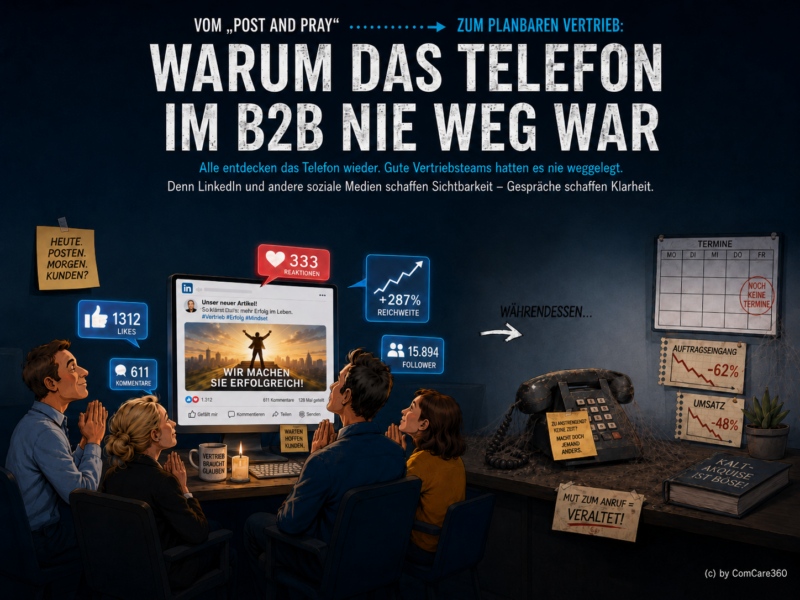
“Post and Pray” hits the quiet corner of the phone: While the feed glows with likes, reach and followers, order intake and sales wait in vain for a conversation.
Why the narrative of sales without a telephone was so successful
The thesis of telephone-free sales was so successful because it hit a sore spot. Because let’s be honest: Hardly anyone likes to make phone calls in a sales context.
And this does not only apply to classic cold calling. The agreed callback, the follow-up to an offer, the previous interested party, the existing customer – all this costs overcoming. A post is easier to write than a phone call is made. A message can be formulated, corrected and scheduled at your leisure. A phone call requires you to be present at the same moment, to react and to expect a real reaction from the other person.
The message “You don’t have to call anymore” was therefore less a sales insight than a tempting promise. It freed from something uncomfortable. The fact that it was so readily believed says more about our relationship to telephoning than about the actual effectiveness of sales channels.
The difference between visibility and sales
This is where the real error in thinking lies. LinkedIn, content and social media can generate attention and visibility. However, visibility is not yet a conversation, not a qualification, not an appointment and not an order.
If you only publish content, send messages and then wait for someone to get in touch, you are not systematically cultivating the market. He does “post and pray”: post, send – and pray that something will come back.
The problem with “Post and Pray” is not the individual post or message. The problem is the lack of a sequel. Attention that is not transferred to a concrete next step fizzles out. And a significant part of the sales success is thus left to chance – the hope that the right person sees the right contribution at the right time and takes action on their own.
Why people remain important at crucial points
Especially in B2B, it’s rarely about fast, exchangeable purchases. It is about complex decisions that require explanation and are economically relevant. And before such decisions, managing directors, purchasing managers and sales managers usually want to talk to a potential partner in person again.
This is not just about factual arguments and a lack of information. It’s about trust, commitment, sympathy and the feeling of working with the right people. This dimension simply cannot be read from likes, clicks or automated reactions. It is created in direct dialogue between two people.
In addition, there is an often overlooked point: Many relevant top decision-makers do not spend their day on LinkedIn. They don’t read every post, don’t see every message, and don’t respond to every digital contact attempt. If you rely exclusively on being noticed online, you are ignoring a significant part of the very people you actually want to reach.
The phone as part of a multichannel process
So that there is no new misunderstanding here: The phone is not played off against LinkedIn, email, content, automation or AI. On the contrary. Each of these channels has its justification – and its specific role in the process.
Visibility & Reach
Imparting competence
Speech
Speed in the process
Research, prioritization, preparation
Clarification, qualification, commitment
LinkedIn and other digital channels create awareness. Content conveys competence. Automation accelerates processes. Artificial intelligence researches data, prioritizes contacts, prepares conversations, and supports your employees. All of this is sensible and modern. But it does not replace the moment when a contact becomes a relationship.
This is exactly where the role of the telephone lies. It is neither an outdated channel nor the new panacea. At certain points in the process, the crucial link: between visibility and contact, between contact and qualification, between interest and appointment and between appointment and concrete business relationship.
So the listener is not the entire distributor. At the crucial points, however, it is the next step that makes everything else effective.
The phone as part of a multichannel process
Each channel has its justification – and its specific task in the process.
Visibility & Reach
Imparting competence
Speech
Speed in the process
Research, prioritization, preparation
Clarification, qualification, commitment
This is exactly where the role of the telephone lies. It is the crucial link at certain points in the process.
What can be clarified in a phone call
An important point in advance, because it is so often misunderstood: Talking on the phone does not automatically mean selling. A good conversation does not have to produce a deal in the end. It often does something much more valuable – it creates clarity.
A single phone call can serve, among other things, to:
- Identify the right contact person,
- get to know a contact in person,
- understand the actual needs and situation of the company,
- Qualify a lead and schedule an appointment
- to send relevant information in a targeted manner,
- set a specific follow-up date,
- Reactivate an existing contact or win back a former customer,
- discover additional potential with existing customers.
The phone call turns an anonymous data set into an actual dialogue. And it is this dialogue that makes a sales process controllable in the first place.
BANT and ABC: Structure for good conversations
In personal dialogue, information can be collected that is not recognizable through pure visibility or digital reactions. To ensure that a conversation does not slip into arbitrariness, a simple orientation helps. The BANT principle has proven itself:
Is there a realistic financial framework in principle?
Are you talking to a decision-maker, a stakeholder or a relevant multiplier?
Is there a concrete need, a problem or a relevant goal?
When could or should the topic be implemented?
BANT and ABC: Structure for good conversations
Is there a realistic financial framework in principle?
Are you talking to a decision-maker, a stakeholder or a relevant multiplier?
Is there a concrete need, a problem or a relevant goal?
When could or should the topic be implemented?
It is important to note that BANT is not a rigid interrogation scheme. It is not a matter of ticking off four questions mechanically, but of understanding in conversation whether and how a contact can be meaningfully processed further.
On this basis, contacts can be divided into A, B and C leads for further processing:
There is a concrete need, and the contact is ready to make an appointment in a timely manner.
Next step: Make an appointment and prepare properly.
There is basic interest, but the contact would first like to receive information, consult internally or still needs time.
Next step: Send relevant information and agree on a specific follow-up time.
Currently, there is no concrete need or suitable timing. The contact will be taken into account for a later approach – in compliance with the applicable legal requirements.
Next step: Document sensibly and check again at the appropriate time.
On this basis, contacts can be divided into A, B and C leads:
There is a concrete need, and the contact is ready to make an appointment in a timely manner.
Next step: Make an appointment and prepare properly.
There is basic interest, but the contact would first like to receive information, consult internally or still needs time.
Next step: Send relevant information and agree on a specific follow-up time.
Currently, there is no concrete need or suitable timing. The contact will be taken into account for a later approach – in compliance with the applicable legal requirements.
Next step: Document sensibly and check again at the appropriate time.
The underestimated opportunities in one’s own data stock
And thus to a point that is regularly lost in the whole debate about new channels. Many companies are constantly investing time and money in new leads – while their own databases and CRM systems have numerous contacts with whom a connection has long been established:
- former prospects and former customers,
- requests that are not consistently tracked,
- Contacts where the timing was not right at the time,
- Offers for which there was never a final response,
- Participants of previous events,
- long-standing existing customers and contact persons whose responsibilities have changed.
These contacts should not only be stored, but also regularly checked, prioritized and addressed personally. Because a contact where there was no need twelve or eighteen months ago can be faced with a completely different situation today. Markets are shifting, budgets are being reallocated, responsibilities are changing, new problems are emerging.
This also applies expressly to existing customers. They should not only get a call when something is to be sold to them. A personal conversation helps to identify changes at an early stage, to understand new needs, to perceive dissatisfaction before terminating, to identify additional opportunities and to initiate recommendations.
The consequence is inconvenient, but rewarding: Your next orders may not be in a newly purchased lead list, but already in your own CRM.
Reactivation does not mean calling old lists indiscriminately. It means intelligently selecting existing contacts, developing a relevant conversation opportunity and personally clarifying what has changed since the last exchange.
The attitude of ComCare 360
At this point, transparency is called for, because ComCare 360 has a clear position on this topic – but a different one than you might think. ComCare 360 does not only rely on telephone communication because of a current LinkedIn trend. For many years, the company has been combining different channels with personal dialogue to create well-thought-out campaigns.
Managing Director Ingo Marggraf is expressly not an advocate of purely traditional telephone sales. On the contrary, he thinks in terms of technology and campaigns and has been dealing with the interaction of marketing, sales, data and technology for many years. He has helped to build up multichannel software providers and agencies and was active in digital marketing at an early stage, including in the environment of the Federal Association of the Digital Economy and e‑mail marketing.
The attitude behind this is therefore not “back to the phone and away from the new channels”. It is: Use all sensible channels – but don’t forget to get people talking to each other at the crucial points.
The decisive factor is not which channel is currently hyped on LinkedIn. The decisive factor is which channel has the greatest effect at which point in the process. New technologies are used where they make processes better, faster and smarter. People come into play where trust, understanding and commitment must arise.
Visibility creates reach. Conversations create business.
The phone is not making a comeback in B2B sales – because it never really disappeared in a professional sales system. It was just discussed quieter than the shinier digital channels for a while.
LinkedIn, content, email, AI, and automation are valuable components of modern campaigns. However, they do not replace personal dialogue. Only when attention becomes a concrete contact, a contact becomes a qualified lead and a lead becomes a binding next step, a sales is created that you can actually control – instead of leaving it to chance.
So perhaps the most honest question to your own sales department is not which new channel to try out next. But: Is our sales a controllable process – or do we mainly post and send and then hope for reactions? When was the last time we systematically contacted previous interested parties? And how many opportunities are currently unprocessed in our CRM?
Enough talking over the phone. Let’s put the theory into practice right away.
You can reach us at +49 4102 7788770.
Or you can use our contact form and let us know when we can call you.

Ingo Marggraf, Geschäftsführer der ComCare 360 GmbH, ist ein erfahrener Experte im Bereich Marketing, Vertrieb, Telemarketing und CRM-Systemen. Mit seinem umfangreichen Wissen und seiner Leidenschaft für innovative Lösungen hilft er Unternehmen dabei, ihren Umsatz zu steigern und erfolgreich zu wachsen.
Ingo Marggraf, Managing Director of ComCare 360 GmbH, is an experienced expert in the fields of marketing, sales, telemarketing and CRM systems. With his extensive knowledge and passion for innovative solutions, he helps companies increase their turnover and grow successfully.