

Every missed handover costs revenue. This will help you bridge the gaps between marketing, sales, and service – and get more out of your budget.
Marketing, sales and service do a lot – and yet sales are lost at the transitions: due to a lack of information, unclear responsibilities and a lack of follow-up actions. The article shows five typical transitions, makes the cumulative effect visible with a simplified example and provides a handover check that you can use to guide existing sales opportunities to the order more consistently.
⏱️ Reading time: approx. 8 minutesPaid, won, written – and still no commission
The campaign is paid. The interested party is won. The offer is written. But the order fails to materialize.
If a crucial piece of information is missing, the promised callback fails to materialize or no one takes the next step, more than an inquiry is lost: Your company loses possible revenue. The costs for advertising, systems and working time have nevertheless been incurred.
A simple calculation example shows how much such losses add up: If 10 percent of the remaining sales potential remains at five crossings, only around 59 percent arrives in the end. Around 41 percent is lost along the way. The original possible turnover of 100,000 euros becomes about 59,000 euros – with resources already used.
This is not a measured industry quota, but a simplified example. However, it shows why it is worth taking a look at the transitions: Every closed gap can enable additional sales and reduce the effort per order won.
The economic leverage is considerable: more sales with comparable effort, the same sales with less effort – or a combination of both. Before you increase your acquisition budget, you should therefore check: Where does your sales get stuck on the way to the customer?
The customer perspective: an example from everyday life
Imagine the following situation – as an example, not as a customer reference: A prospect responds to a campaign and explains his needs. The next time he is contacted, he has to start all over again. After the offer, a question remains unanswered, but no one takes the next step.
The individual tasks have been completed internally: the request has been processed, the conversation has been held, the offer has been sent. For the customer, however, the process remains tedious and unclear. If he decides against the provider for this reason, possible sales are lost, even though effort has already been incurred.
This rarely has to do with a lack of commitment on the part of individuals. It arises where one responsibility ends before the next clearly begins.
From the customer’s point of view, it doesn’t matter which department is responsible at the time. He expects that his concern has been understood, that promises are valid and that someone knows how to proceed. Every repetition, every waiting time and every open question costs trust – and trust is the basis of every purchase decision in B2B business. So the question is not who made a mistake, but at what point the customer got stuck.
Five transitions where revenue can be lost
The customer journey can be divided into five transitions. In each of them, the customer problem, revenue risk and unnecessary effort are closely related.
Campaign → first contact
Initial contact → sales
Discussion → offer
Offer → decision
Conclusion → support
In none of the five cases is there a lack of commitment. Each department does its job, but there is a gap between the tasks. This is precisely why such losses often go unnoticed: they do not appear in any single key figure, but only show up in the overall result – as orders that never came about.
The calculation example: How 10 percent adds up five times
A simplified example makes the cumulative effect tangible. At five consecutive transitions, 10 percent of the remaining sales potential is lost:
| Stage | Potential | Loss |
|---|---|---|
| Initial potential | €100,000 | |
| After transition € | 1,90,000 | – €10,000 |
| After transition 2 | €81,000 | – €9,000 |
| After transition 3 | €72,900 | – €8,100 |
| After transition 4 | €65,610 | – €7,290 |
| After transition 5 | €59,049 | – €6,561 |
In total, 40,951 euros or around 41 percent of the original potential are missing. The losses are not simply added to 50 percent, because each loss is deducted from the already reduced remainder.
The example is a model calculation with equivalent sales potential and consecutive losses. It is neither a study result nor an industry quota or a guaranteed additional turnover. It is only intended to show how small gaps add up to a significant economic effect.
More sales, less effort – or both
Better handovers ensure that sales opportunities that have already been won become more. At the same time, complete information and clear responsibilities reduce duplication of work, queries and unnecessary waiting times. This results in three possible outcomes:
The following applies: Additional orders can cause further processing and service costs. Improved processes therefore do not automatically enable additional sales without any additional effort. Above all, they improve the ratio of effort and income.
The effort per won order is therefore the central variable: How much advertising, system use and working time is there on average in a deal? If this value decreases, the same budget becomes more effective – regardless of whether you use the result in additional orders or in free capacities.
Connecting people, processes, and systems
The following figure shows what it’s all about: at the top the breaks between marketing, sales, closing and service, at the bottom the connections between customer knowledge, responsibility and a clear next step.
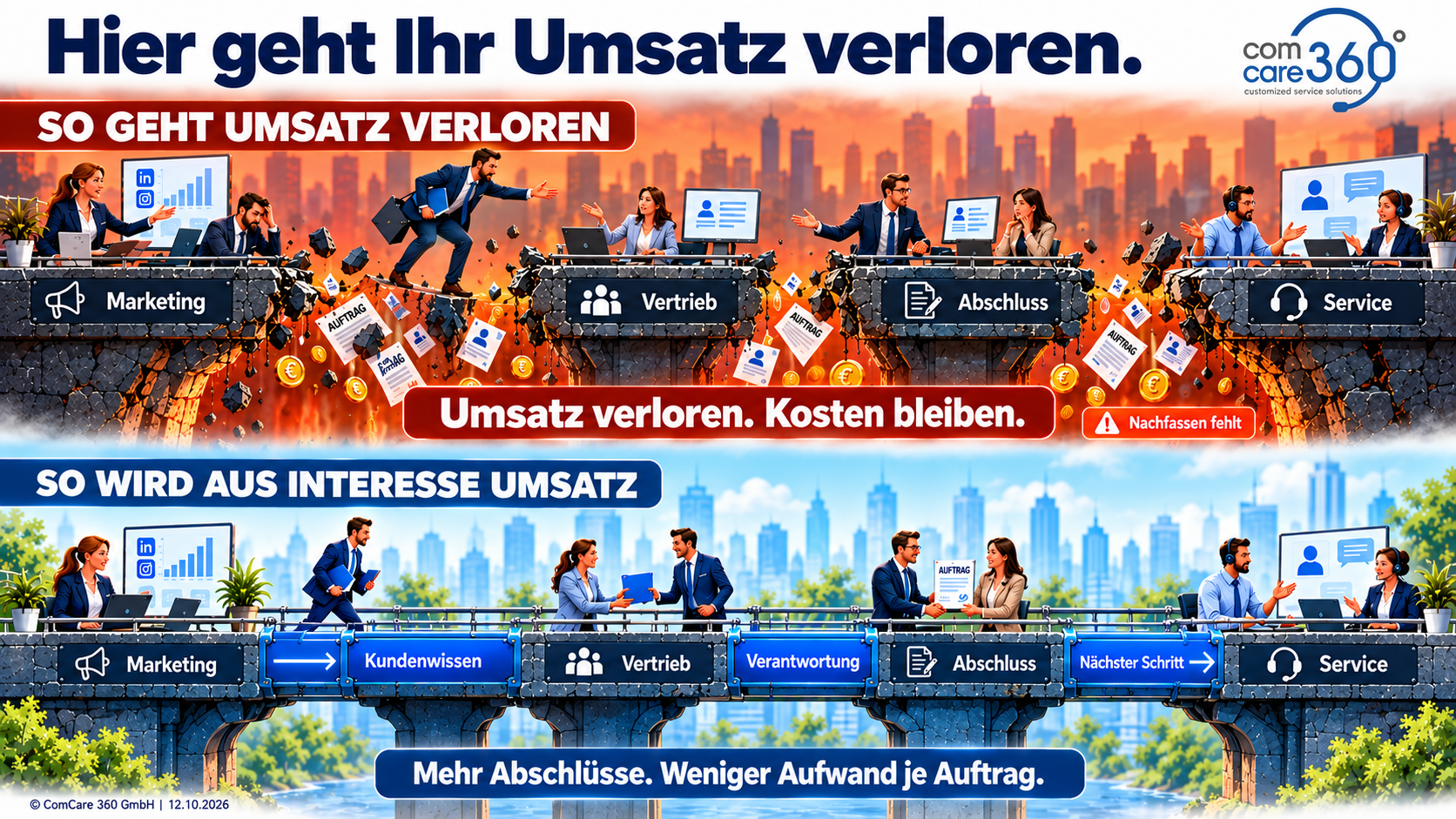
The three connections in the image can be translated into concrete terms in practice. Customer knowledge means that relevant information is recorded once and documented for everyone to see. Responsibility means that a name is fixed for each process. Finally, the next step needs an appointment so that it does not depend on chance. The following levers help with this:
- One person responsible for every next step.
- Joint documentation of relevant customer information.
- Qualification that captures the actual need.
- Binding tasks and appointments in the CRM.
- Automated reminders and routine processes.
- Personal conversations when there are questions, uncertainty or a need for decision-making.
A CRM creates transparency and supports implementation. Technology and AI can prepare, structure and relieve the workload. It is crucial that the customer makes reliable progress.
The handover check for your practice
A compact check helps to check handovers in everyday life. Ask yourself six questions with each handover:
Take a specific customer case and follow it from the first contact to support. Where did the process falter? What sales opportunity was at stake? What additional effort was incurred?
The check becomes particularly revealing when marketing, sales and service go through it together. Then it becomes clear which information was missing at which point – and which habit or system entry will make it available in the future. Even a single case examined usually provides several concrete starting points.
How ComCare 360 supports
the transitions The key is the interaction. It reduces revenue losses and makes existing resources more usable:
- Qualification and scheduling for informed sales conversations.
- Telesales and consistent follow-up of open opportunities.
- HubSpot for shared customer information, responsibilities, and follow-up actions.
- Email marketing and telephony for aligned contact routes.
- Customer service and quality calls to address expectations and experiences after closing.
The order is important: First there is the question of where your turnover is stuck, then the selection of suitable measures. Not every gap needs a new system. Sometimes a clear responsibility or a binding callback date is sufficient, sometimes additional capacity is needed for consistent tracking.
Conclusion
Revenue is rarely lost at a single point, but where information, responsibilities and follow-up actions do not interlock. If you systematically check these transitions, you will improve the revenue from campaigns, systems and working time that have already been paid.
More budget for acquisition is therefore not always the first step. It is often worth taking a look at what happens to the existing sales opportunities first.
The start does not have to be large. A single customer case, a joint view of marketing, sales and service and the willingness to honestly name open handovers are enough to find and close the first gaps.
How much revenue do you have left between the inquiry, conversation, offer and closing?
Every missed callback, every lost information and every unexplained next step can cost you an order. At the same time, you have already invested in the acquisition and processing of this prospect.
Let’s check together where you are missing out on sales and where unnecessary costs are incurred. ComCare 360 combines qualification, personal customer meetings, consistent follow-up and suitable CRM processes so that more of your existing sales opportunities become an order.
Our common goal: more revenue from your existing budget and less effort per deal. We clarify which improvements will bring the greatest economic benefit to you based on your specific customer journey.
Call us: +49 4102 7788770
Or use our contact form: https://comcare360.de/kontakt/

Ingo Marggraf, Geschäftsführer der ComCare 360 GmbH, ist ein erfahrener Experte im Bereich Marketing, Vertrieb, Telemarketing und CRM-Systemen. Mit seinem umfangreichen Wissen und seiner Leidenschaft für innovative Lösungen hilft er Unternehmen dabei, ihren Umsatz zu steigern und erfolgreich zu wachsen.
Ingo Marggraf, Managing Director of ComCare 360 GmbH, is an experienced expert in the fields of marketing, sales, telemarketing and CRM systems. With his extensive knowledge and passion for innovative solutions, he helps companies increase their turnover and grow successfully.